
Commodity prices can change several times during a single trading day. For companies dealing with oil, metals, mining products, agricultural commodities, or chemicals, even a small price movement can affect contracts, settlements, profitability, and risk exposure.
This is where a Commodity Pricing Engine (CPE) becomes important.
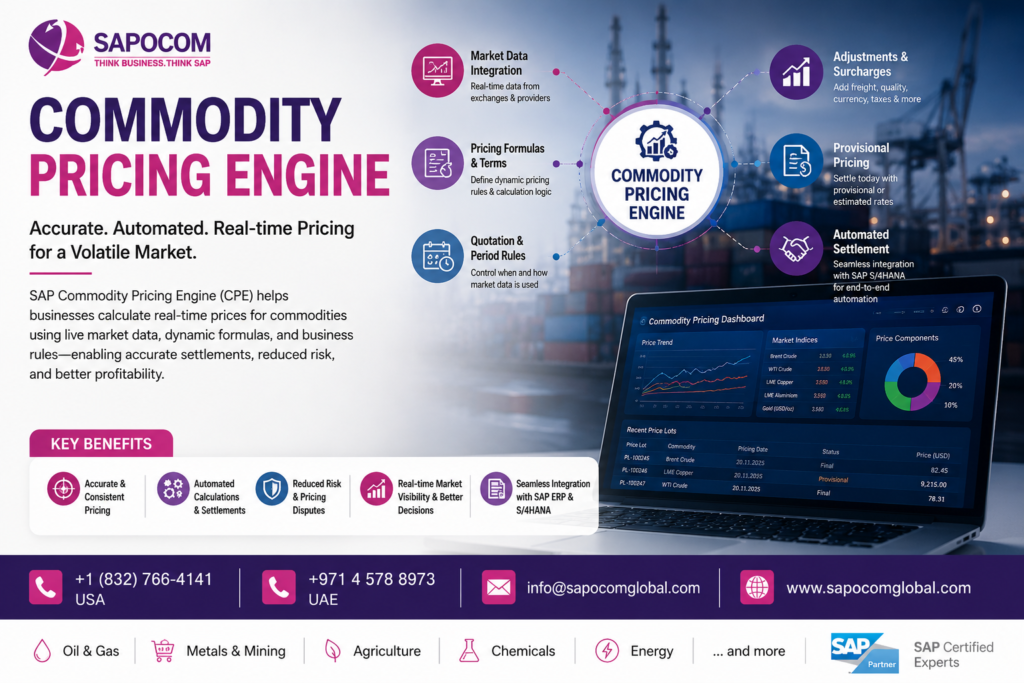
A Commodity Pricing Engine is a specialized pricing solution that automatically calculates commodity prices using market data, pricing formulas, contract terms, quotation periods, and business rules. Instead of relying on spreadsheets and manual calculations, organizations use a pricing engine to ensure consistent and accurate commodity pricing across procurement, sales, trading, and settlement processes.
For businesses running SAP environments, the SAP Commodity Pricing Engine (CPE) helps integrate commodity pricing directly into operational and financial workflows.
What Is a Commodity Pricing Engine?
A Commodity Pricing Engine is a software component designed to calculate commodity prices based on predefined formulas and real-time market information.
The engine retrieves pricing rules from contracts and combines them with external market data sources to determine the final transaction price.
A pricing engine can calculate values for:
- Crude oil
- Natural gas
- Copper
- Aluminum
- Gold
- Silver
- Iron ore
- Agricultural products
- Chemicals
- Energy commodities
Unlike fixed-price transactions, commodity contracts often include variable pricing conditions that depend on market movements, quotation periods, quality factors, transportation costs, and currency exchange rates.
The Commodity Pricing formula automates these calculations.
Why Commodity Pricing Is Complex
Commodity transactions rarely use a single fixed price.
A contract may include:
- Market index references
- Average pricing periods
- Premiums and discounts
- Freight adjustments
- Quality differentials
- Currency conversions
- Tax considerations
- Settlement dates
For example, a copper supplier may agree to sell material using the average London Metal Exchange (LME) price over a specified quotation period, plus a negotiated premium.
Without automation, managing these calculations across hundreds or thousands of contracts becomes difficult.
How a Commodity Pricing Engine Works
The pricing process typically follows several steps.
1. Market Data Collection
The system retrieves commodity prices from market data providers and exchanges.
Examples include:
- LME
- CME
- NYMEX
- ICE
- Platts
- Argus
The pricing engine continuously updates market references used in contract calculations.
2. Formula Evaluation
Each contract contains pricing logic.
The system evaluates:
- Fixed price elements
- Variable pricing components
- Premiums
- Discounts
- Index-based calculations
The engine then calculates the applicable commodity value according to contract terms.
3. Quotation Period Processing
Many commodity contracts rely on specific quotation periods.
Examples include:
- Monthly averages
- Weekly averages
- Forward pricing windows
- Shipment-based pricing periods
The engine automatically applies the correct market values based on contract conditions.
4. Settlement Calculation
After evaluating all pricing variables, the system calculates the final settlement amount.
This information can then flow into:
- Procurement documents
- Sales orders
- Trade settlements
- Financial postings
- Invoice generation
What Is SAP Commodity Pricing Engine (CPE)?
The SAP Commodity Pricing Engine is a pricing framework designed for businesses that buy, sell, trade, or process commodities.
It extends standard SAP pricing capabilities by supporting complex commodity pricing structures that are commonly used in:
- Oil and gas
- Metals and mining
- Agriculture
- Chemicals
- Commodity trading organizations
The solution helps businesses automate pricing calculations while maintaining consistency across operational and financial systems.

Key Features of SAP Commodity Pricing Engine
Formula-Based Pricing
SAP CPE allows organizations to build pricing formulas based on business requirements.
These formulas may include:
- Market references
- Fixed values
- Premiums
- Discounts
- Conversion factors
Market Data Integration
The platform can integrate market quotations from approved pricing sources.
This reduces manual data entry and improves pricing accuracy.
Provisional Pricing
Commodity contracts are often settled before final market prices are available.
SAP CPE supports provisional pricing by allowing temporary settlements until final prices are confirmed.
This capability is widely used in commodity trading environments.
Automated Settlement
The engine automatically calculates final prices and updates business documents across SAP processes.
This reduces operational effort and minimizes pricing errors.
Contract Flexibility
Organizations can support a wide range of commodity pricing models without extensive customization.
Industries That Use Commodity Pricing Engines
Oil and Gas
Energy companies use pricing engines to calculate values for:
- Crude oil
- Refined products
- Natural gas
- LNG transactions
Commodity pricing engines are often integrated with transportation, inventory, and trading systems.
Metals and Mining
Mining organizations rely on market-linked pricing for:
- Copper
- Aluminum
- Zinc
- Iron ore
- Precious metals
Contract settlements frequently depend on exchange prices and quality specifications.
Agriculture
Agricultural businesses use pricing engines for:
- Grain contracts
- Oilseeds
- Sugar
- Cotton
- Feed commodities
Seasonal market fluctuations make automated pricing particularly important.
Chemicals
Chemical manufacturers often use commodity-linked pricing structures for raw materials and feedstocks.
Benefits of a Commodity Pricing Engine
Businesses implementing commodity pricing solutions often seek improvements in:
Pricing Accuracy
Automated calculations reduce errors associated with spreadsheets and manual processes.
Faster Settlements
Contract settlements can be processed more efficiently when pricing data is automatically applied.
Better Compliance
Centralized pricing rules help organizations maintain consistency and auditability.
Reduced Operational Risk
Automated pricing reduces dependence on manual calculations and individual expertise.
Improved Visibility
Organizations gain better insight into commodity exposure, pricing positions, and contract performance.
Commodity Pricing Engine and SAP Commodity Management
Many businesses implement Commodity Pricing Engine alongside SAP Commodity Management solutions.
Together, these systems support:
- Commodity procurement
- Commodity sales
- Contract management
- Inventory valuation
- Trade settlement
- Risk management
This integration allows pricing decisions to flow directly into operational and financial processes.
Common Challenges in Commodity Pricing
Organizations often face challenges such as:
- Volatile market conditions
- Multiple pricing sources
- Complex contract structures
- Currency fluctuations
- Regulatory requirements
- Large transaction volumes
A Commodity Pricing Engine helps address these challenges through standardized pricing processes and automation.
Final Thoughts
A Commodity Pricing Engine is much more than a pricing calculator. It serves as a critical component for organizations that operate in commodity-driven industries where prices change frequently and contract structures are often complex.
By combining market data, pricing formulas, quotation rules, and settlement processes, the engine provides a consistent approach to commodity pricing across the business.
For companies using SAP, the SAP Commodity Pricing Engine offers a structured framework for managing commodity pricing requirements while connecting commercial operations with procurement, trading, finance, and supply chain processes.